




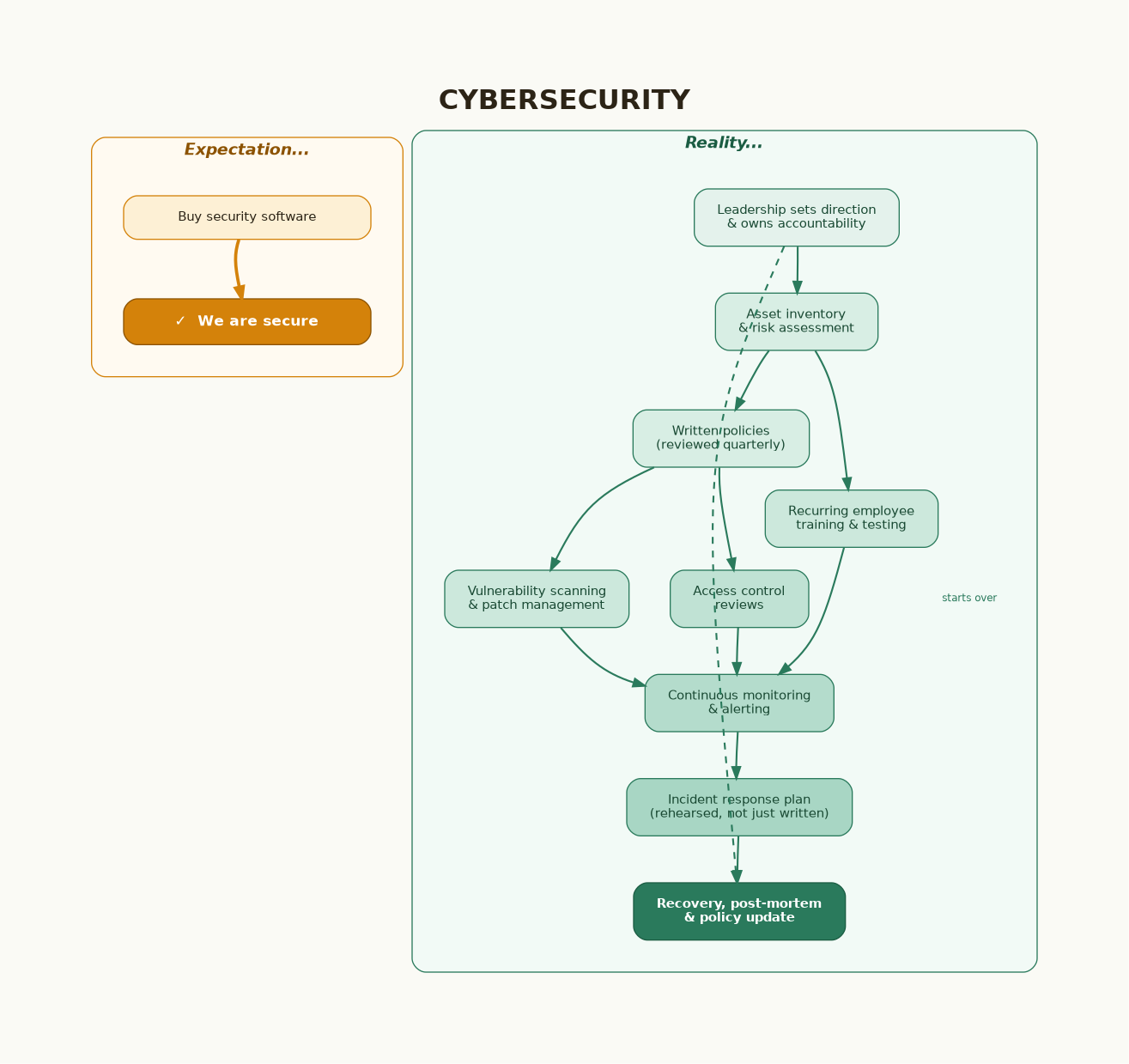
I've had the same conversation more times than I can count. A founder or operations lead calls me in with a clear ask: install the right security software — an antivirus, a firewall, a vulnerability scanner, whatever it takes — and guarantee our code is secure. The request is sincere. The mental model behind it is the problem.
No software does that. The belief that it can is, precisely, the vulnerability.
What Clients Actually Mean by "Security Software"
When most organizations say "get us secured," they mean software. An antivirus. A WAF. A SIEM. A vulnerability scanner. Buy the right product, deploy it, move on.
This is a category error — like believing you can purchase "financial health." Financial health is not a product. It is a set of ongoing behaviors: tracking expenses, managing cash flow, reviewing forecasts, adjusting when things change. Stop doing those things and the health disappears, regardless of what software you bought.
Security is the same. It is an operational state that requires continuous maintenance by people who understand it — not a one-time purchase that grants an outcome.
NIST Cybersecurity Framework 2.0 is instructive here. Tools — firewalls, scanners, SIEMs — belong under Protect, which is just one of six functions. Before Protect comes Govern and Identify. After it come Detect, Respond, and Recover. Software cannot govern itself, identify what matters to your business, or run your incident response. Those require people, policy, and practiced process.
The Data Shows the Same Gap
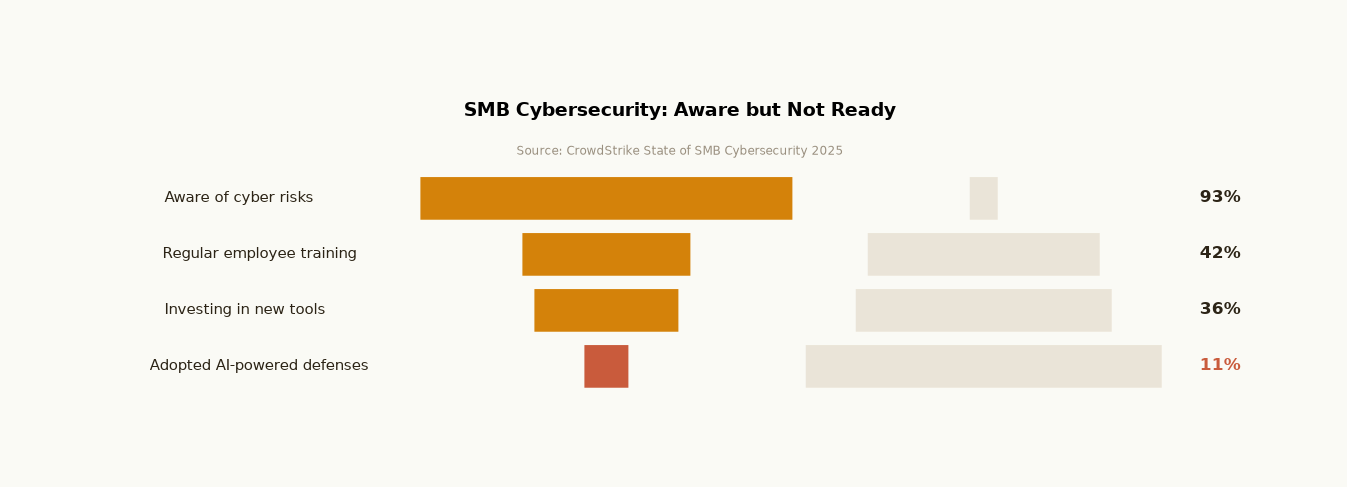
CrowdStrike's 2025 State of SMB Cybersecurity report found that 93% of SMBs consider themselves knowledgeable about cyber risks.[1] The same survey found that only 42% provide regular cybersecurity training to employees. Only 36% are investing in new tools. Nearly 6 in 10 fail at security basics — applying patches and enforcing multi-factor authentication.
These are not organizations that don't know threats exist. They are organizations with the wrong understanding of what security requires.
The same pattern plays out in Korea. In the first half of 2025, KISA recorded 1,034 breach incident reports — a 15% increase year-on-year — despite the government actively subsidizing security tools for SMBs through free distribution programs.[2] Tools reached organizations that were not ready to use them as part of a real security practice.
The One Question That Reveals the Gap
I have found one question that cuts straight to the real state of an organization's security: What does your incident response look like right now, during an active breach?
Not a theoretical plan. The actual sequence of events: who gets notified first, which systems get isolated, who calls customers, who speaks to legal. If that answer is unclear, no tool fills the gap. A firewall won't tell your staff what to do. An antivirus won't preserve your forensic evidence. A compliance certificate won't contain a breach that's already spreading.
The organizations that answer that question confidently have practiced it — tabletop exercises, documented runbooks, trained people who have role-played the scenario. None of that is sold in a box.
Here are three things you can do this week without hiring anyone:
- Designate a breach response owner. One person — not a committee — whose job is to coordinate when something goes wrong. Write their name down somewhere everyone can find it.
- Write a one-page notification chain. Who gets called first, second, third during an incident. Phone numbers included. This takes one afternoon and exists nowhere in most SMBs.
- Schedule a 90-minute tabletop exercise. Pick a ransomware scenario. Walk your team through it out loud. You will find the gaps faster than any scanner will.
Security is not a program you buy. It is an ongoing practice your organization builds — through policy, training, tested processes, and leadership that takes ownership. Every year that assumption goes unchallenged costs more than the year before.
When did your organization last run a breach simulation — and what broke?
References
- CrowdStrike — State of SMB Cybersecurity 2025
- KISA — 2025 상반기 사이버 위협 동향 보고서
- NIST — Cybersecurity Framework 2.0
 Instagram