



Every server you add, every database you fill, every customer you acquire — your business is expanding. So is your exposure. Not because you've become careless, but because growth changes two things that attackers actively track: how much attack surface you present, and how much your data is worth stealing.
Two Filters. Growing Companies Pass Both.
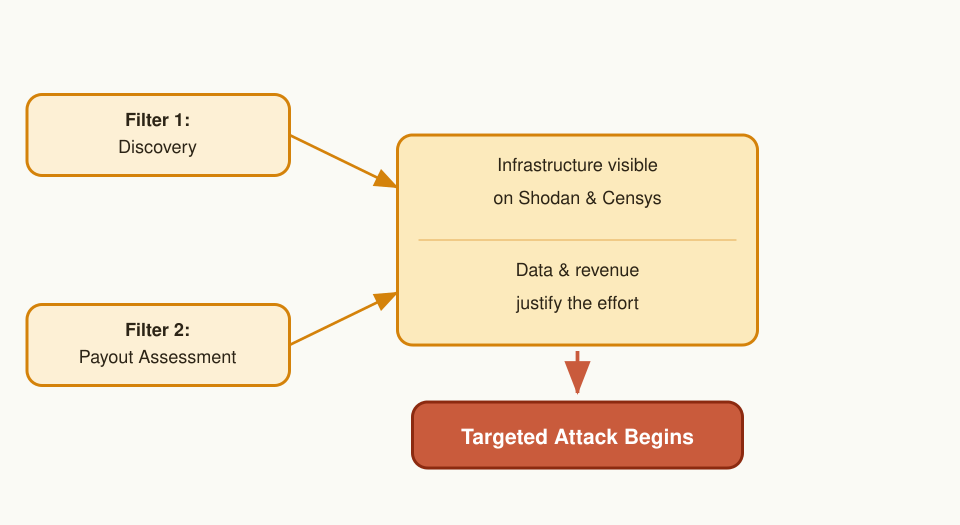
Internet-wide scanning is continuous and automated. Within minutes of a server going live, it appears in tools like Shodan and Censys. Every business with internet presence gets noticed — size is no longer a shield at the discovery stage.
What changes as you grow is the second filter: payout assessment. Attackers running financially motivated operations — and Microsoft's 2025 Digital Defense Report confirms that 52% of attacks with known motivations are financially driven[1] — don't invest the same effort in every target they find. They estimate yield against effort. A small operation with minimal customer data is a low-yield target; the math doesn't favor deep investment.
A growing business rewrites that math. More customers means more personal data. More revenue means more leverage in a ransomware negotiation. More infrastructure means more lateral movement paths once inside. When you cross certain thresholds, you stop being a target of opportunity and start being a target of deliberate effort.
The evidence supports this. Microsoft's 2025 report finds that over 70% of human-operated ransomware attacks targeted organizations with fewer than 1,000 employees.[1] Verizon's 2025 DBIR shows 88% of SMB breaches involved ransomware — compared to 39% at large organizations.[2] In Korea, KISA data shows 93% of all breach incidents hit SMBs and mid-size companies.[3] The average SMB breach cost: $140,000.[4]
These are not random victims. They are companies that grew past the "not worth it" threshold without growing their defenses alongside.
Build Your Threat Model in 10 Minutes
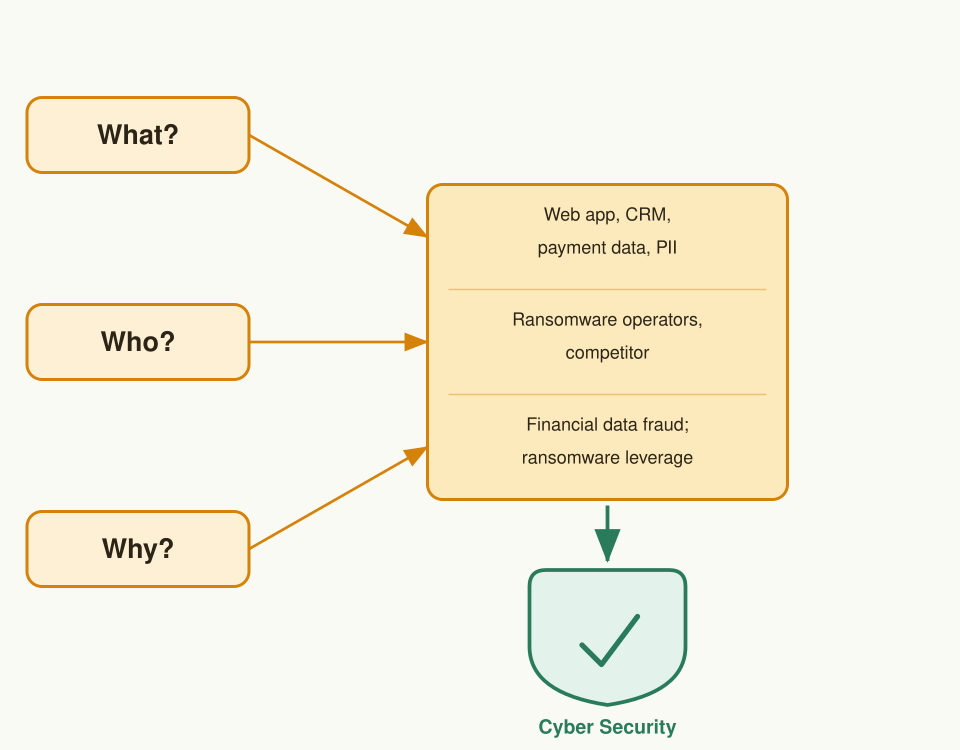
You don't need a CISO to reason about your risk. Three questions are enough:
- What? Your assets — every system that touches customer data or runs your operations: website, internal tools, cloud storage, payment processors.
- Who? The realistic attacker. Financially motivated ransomware groups are the most likely answer for most growing companies. State-sponsored actors only matter in specific sectors (defense, pharma, critical infrastructure). Competitors are rare.
- Why? Their motivation — money (ransomware, fraud), customer data (resale, identity theft), or operational disruption. The goal determines what they'll target first.
Ten minutes. The output is not a security plan — it's a lens. With it, you can evaluate every security decision through the right question: does this actually reduce my specific risk, given who is after me and why?
Most growing companies invest in the wrong controls because they never asked these questions. They buy antivirus for a threat model that calls for network segmentation. They train employees on phishing when ransomware operators are already exploiting an unpatched server facing the internet.
Before You Decide This Doesn't Apply to You
The "I'm too small to be a target" excuse collapses the moment you have data worth stealing or enough revenue that a ransomware operator calculates a payment is likely. For most companies past the early startup phase, both conditions are already true.
Have you ever mapped what an attacker would actually go after in your systems — and whether your current security spending would stop them?
References
- Microsoft — Digital Defense Report 2025
- Verizon — 2025 Data Breach Investigations Report
- KISA — 2025 상반기 사이버 위협 동향 보고서
- NinjaOne — 7 SMB Cybersecurity Statistics for 2026
 Instagram