




WhatsApp privacy rests on one comforting fact: your messages are end-to-end encrypted, so nobody — not even Meta — can read them. That part is true. But encryption protects the content of a conversation, not the shape of it. WhatsApp doesn't need to read a single message to know who you talk to, how often, when, and from where. The encrypted envelope is real — it just has windows cut into it on purpose. This is part one of a three-part series on what that framing actually covers, and what it quietly doesn't.
The encryption is genuinely good
Credit where it's due. WhatsApp's end-to-end encryption is the Signal Protocol — the same cryptographic core that powers Signal, widely regarded as the strongest mainstream messaging encryption available.[1] When a viral hoax claimed Meta would start "reading your DMs," fact-checkers rated it false, because personal message content stays sealed.[2] So the headline is simple: they can't read your texts — and they don't need to.
Metadata privacy is where the envelope leaks
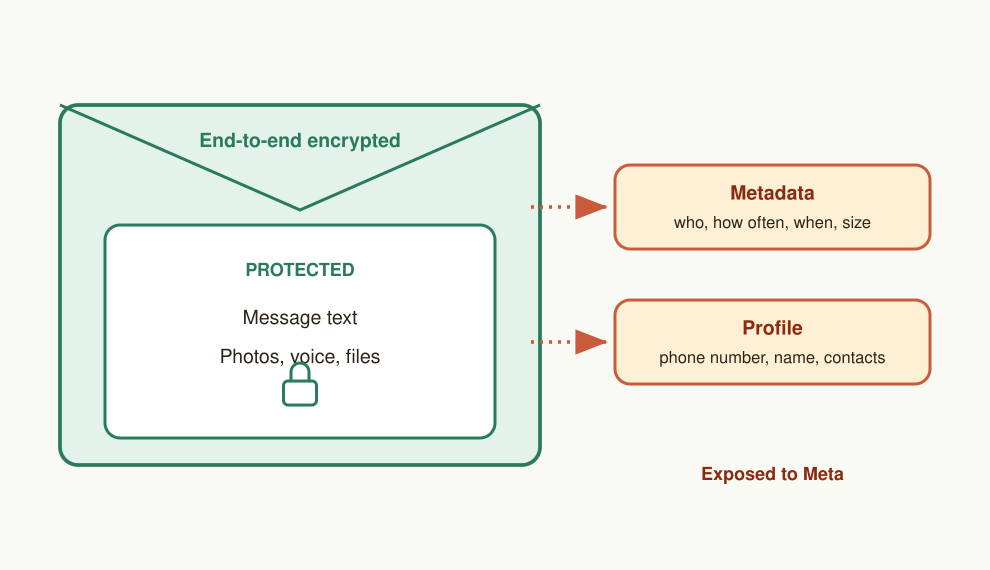
Encryption seals what's inside the message. Everything around it stays visible — the metadata the service needs to route traffic, plus your non-encrypted profile.
What metadata reveals
Inferring who matters to you from communication patterns alone is a long-established result, not a hypothetical — a Stanford study found telephone metadata is enough to map relationships and infer sensitive traits.[4] Who you contact, when, and how often is often enough to reconstruct a social graph:
- Close ties
- Your work circle
- A relationship you've told no one about
Here's the proof. When Signal is subpoenaed, it can hand over almost nothing — it simply doesn't keep that data.[5] When WhatsApp is subpoenaed, it can turn over IP addresses, device details, your connections, and when you were last online — the categories its own privacy policy says it collects.[3] Same crypto, opposite data posture — that difference isn't technical, it's a business decision.
The takeaway
End-to-end encryption is real and valuable, but narrow: understanding its limitations — that it guards content and nothing around it — is the difference between feeling private and being modeled.
If you mapped your own messaging the way an ad system does, what would your metadata alone reveal, even with every message body sealed?
References
- Signal — Signal Protocol documentation
- Snopes — Did Meta's policy update let it read users' DMs?
- WhatsApp — Privacy Policy
- Mayer, Mutchler & Mitchell — Evaluating the privacy properties of telephone metadata (PNAS, 2016)
- Signal — Government requests / transparency

 Instagram