




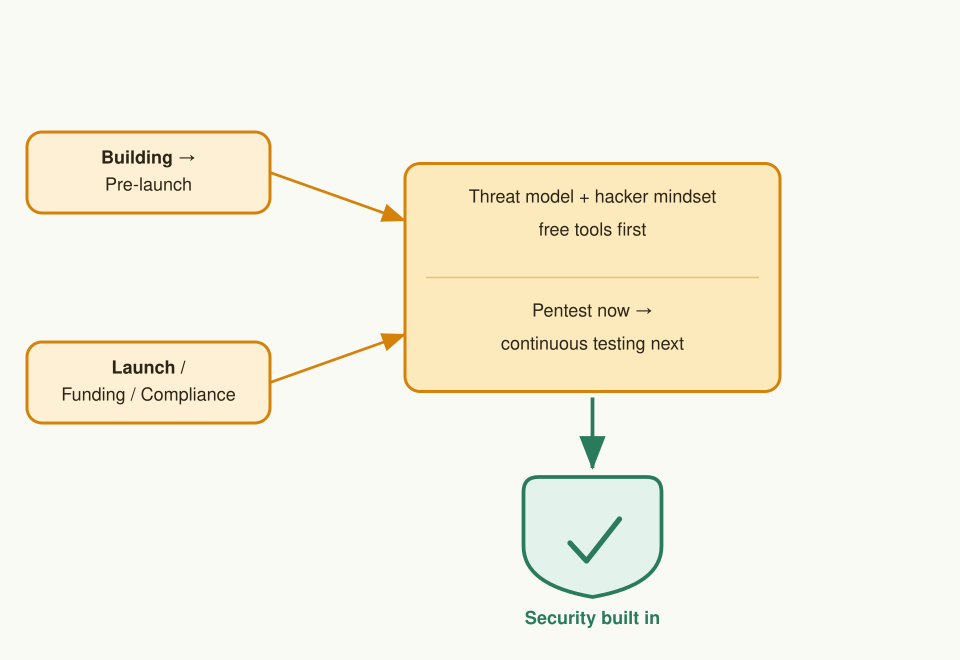
The question most startup founders ask: "When should we get a penetration test?" The question worth asking first: "Are we building in a way that makes us hard to breach in the first place?"
The answer to the second question will change how urgently you need the first one.
Build Security In, Not On
The most expensive security is the kind you bolt on after something goes wrong. And the most expensive pentest is the one that finds dozens of issues in a system that was never designed with an attacker in mind.
You don't need a security team to start. Two practices make a meaningful difference before any test engagement:
Threat model before you build. Before designing any feature that touches user data, ask: what would an attacker target here, and why? Broken Access Control is the #1 issue in the OWASP Top 10 2025 — and it's almost always a design decision, not a coding mistake. It appears in systems where no one stopped to ask "who should actually be allowed to see this?" A 30-minute conversation before writing code catches this class of flaw at zero cost.
Develop with a hacker mindset. Don't only ask "does this work?" Ask "how would someone break this?" A development team that regularly asks the second question ships far fewer exploitable vulnerabilities — before a pentest ever has to find them. (See our post on threat modeling from a business owner's perspective for a practical starting framework.)
When a Pentest Is Warranted
Security-first culture reduces the blast radius of a pentest — it doesn't eliminate the need for one. There are clear trigger points where a professional engagement becomes the right move:
- Before launch. Your first paying customers deserve a product that has been tested by someone actively trying to break it.
- Before Series A or a compliance audit. SOC 2, ISO 27001, and most investor security reviews will expect at least one prior engagement on record.
- After a major architecture change. New integrations, new cloud infrastructure, and new authentication flows all expand your attack surface in ways that aren't obvious until tested.
Not ready for a full engagement yet? Start at the beginning of this path and escalate when the findings warrant it:
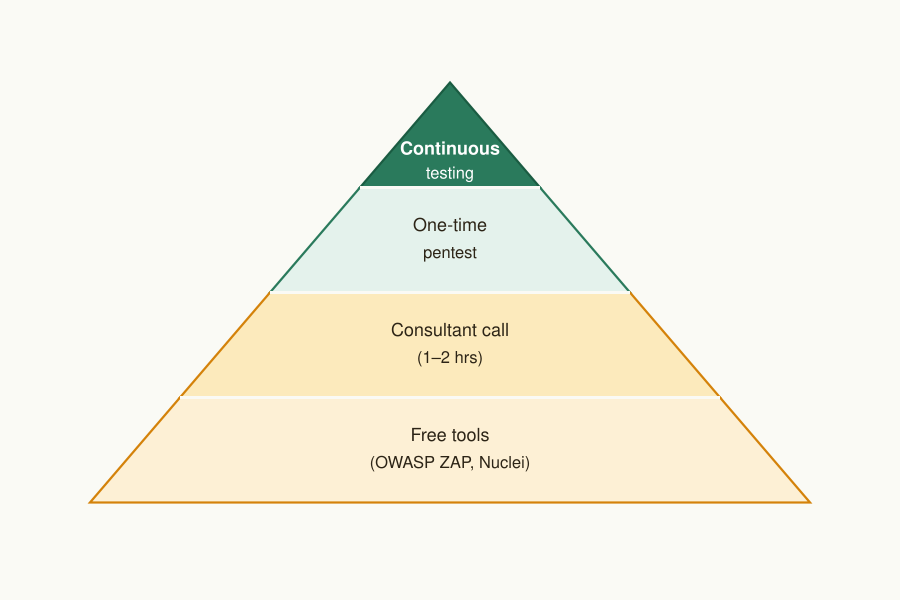
The Continuous Testing Horizon
A once-a-year pentest is a floor, not a ceiling. The goal is continuous validation. AI-powered tools are making this increasingly accessible: XBOW, an autonomous pentesting agent, reached the top spot on HackerOne's US leaderboard in 2025 — a concrete sign of how fast the gap between automated and human testing is closing.
A practical entry point: ask an LLM to review your codebase for security vulnerabilities. If it flags critical issues, treat that as an urgent signal — an experienced team will find considerably more.
Security is not a milestone you hit once. It's a discipline you build into how your company operates from day one.
Where does your company sit on this ladder right now — and does your current security investment reflect your actual stage?
 Instagram