




In 1985 a video-rental chain filled its ads with a Woody Allen look-alike, and Allen sued over it — using a 1946 trademark law that never once says the word "endorsement." He won. How a statute silent on the very idea grew into the rule that now governs celebrity sound-alikes, hidden metatags, and AI-written fake reviews is the story here, and it runs a good deal stranger than the tidy line that law always trails technology.
The history
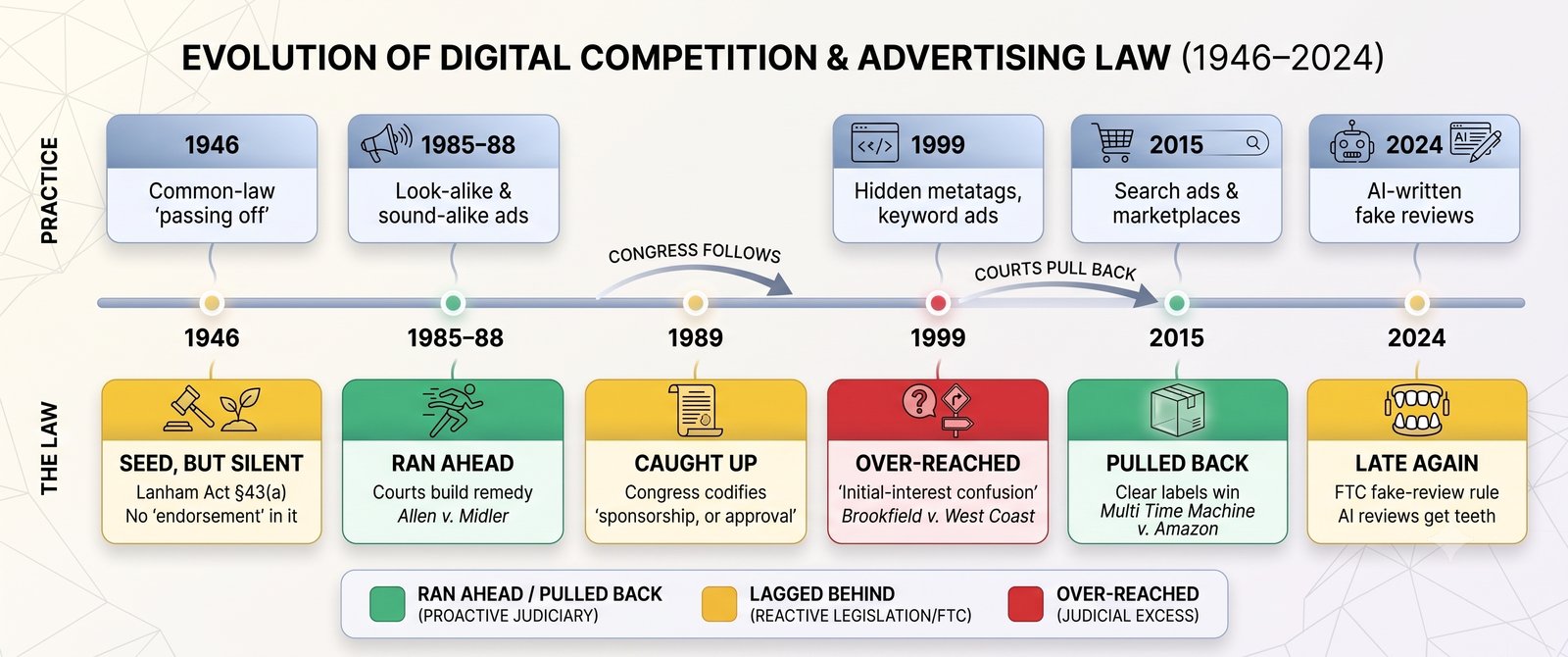
The Lanham Act of 1946 gave brands a federal claim for a "false designation of origin" — section 43(a) — but it said nothing about endorsement, sponsorship, or approval. Those words were not in the text. Through the 1980s the courts filled the gap themselves: when advertisers hired look-alikes and sound-alikes to conjure stars like Woody Allen and Bette Midler, judges treated the implied blessing as actionable years before Congress caught up. Only in 1989 did the Trademark Law Revision Act rewrite section 43(a) to reach confusion over "affiliation … sponsorship, or approval."
Then the doctrine overshot. Online, Brookfield v. West Coast (1999) stretched "initial-interest confusion" to hidden metatags, and courts kept widening it until Multi Time Machine v. Amazon (2015) pulled back, holding that clearly labeled search results confuse no one. Regulators trailed furthest of all: the FTC issued a dedicated fake-review rule, with penalties up to $51,744 per violation, only in 2024 — long after fake reviews were everywhere. The chase never ran in a straight line: it ran ahead, overshot, and lagged by turns.
Why it matters to you
Strip away the case names and implied endorsement is one simple move: make you believe someone you trust vouched for something, without them ever saying so. It is the same move behind a five-star review a bot wrote, a look-alike storefront, and a celebrity's cloned voice reading a scam script. The law is still catching up to the newest versions, so for now the surest protection is your own eye for a manufactured vouch — the instinct to ask who actually said this, before you believe the endorsement.
Which will move first on AI-generated endorsements and synthetic voices — the courts, or the regulators?
This essay is general information about legal history, not legal advice. The author is not a lawyer.
References
- Lanham Act, 15 U.S.C. § 1125 — Legal Information Institute
- Allen v. National Video, 610 F. Supp. 612 (S.D.N.Y. 1985) — Justia
- Midler v. Ford Motor Co., 849 F.2d 460 (9th Cir. 1988) — Justia
- Trademark Law Revision Act of 1988, Pub. L. 100-667 — Congress.gov
- Brookfield Communications v. West Coast Entertainment, 174 F.3d 1036 (9th Cir. 1999) — Justia
- Multi Time Machine v. Amazon.com, 804 F.3d 930 (9th Cir. 2015) — Justia
- FTC Rule on the Use of Consumer Reviews and Testimonials, 16 CFR Part 465 — Federal Trade Commission

 Instagram