




We opened a ChatGPT image and a Gemini image. Inside the hidden block each one carries (the metadata), both files had a line saying the picture is watermarked. You can easily delete that line from the file. Even if the watermark stays behind, deleting the metadata is enough to "fool" most social media platforms, at least for now. Here is what you can find in the metadata of an AI image, and what you get by deleting it.
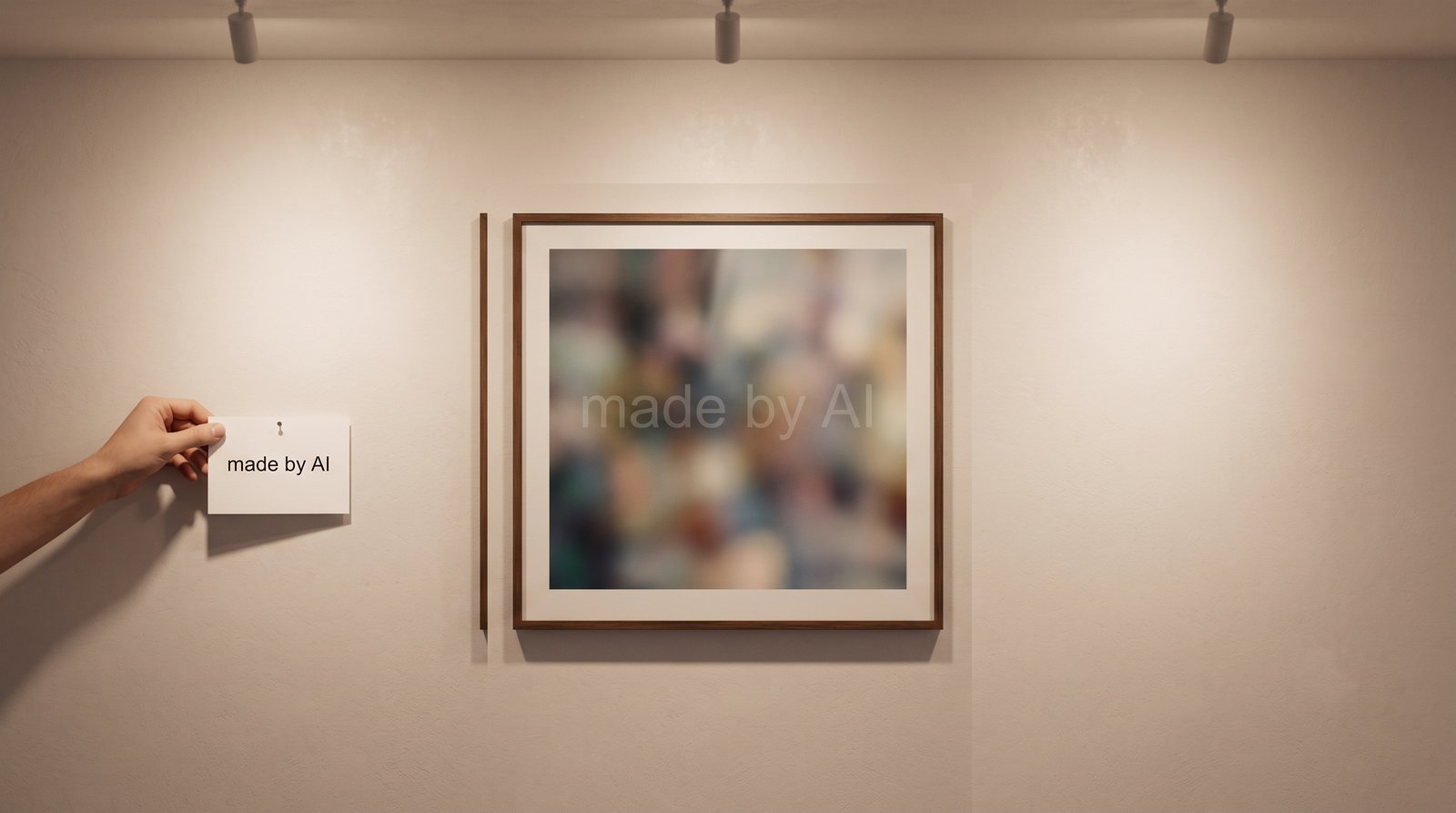
"I am watermarked!", the file screamed
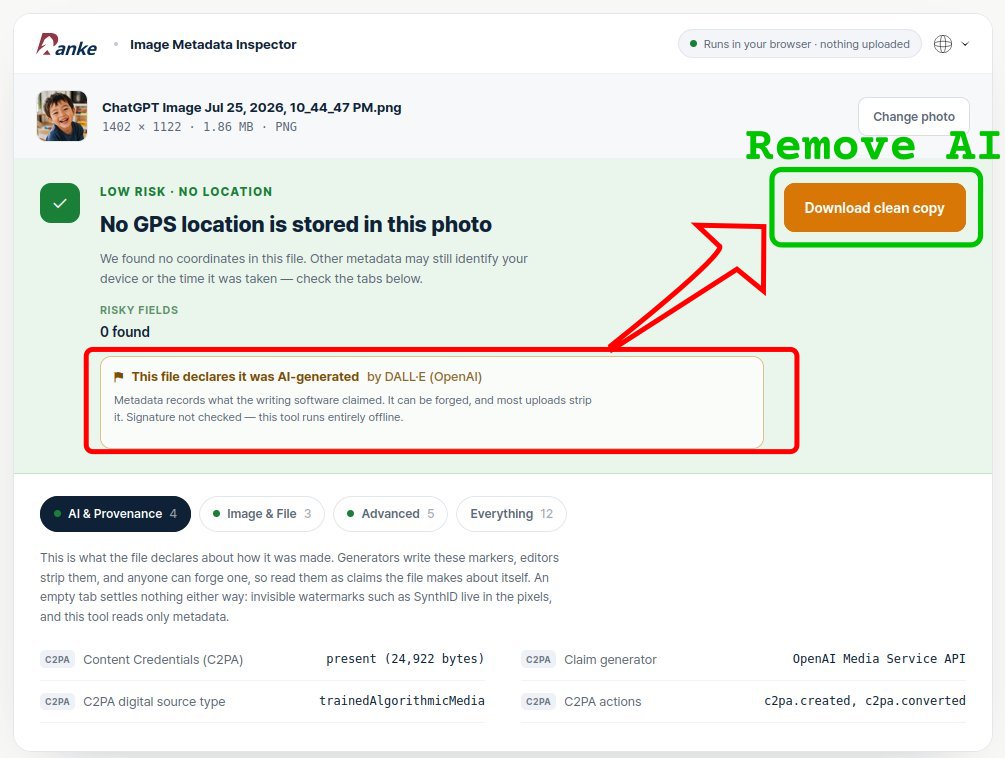
The ChatGPT image we analyzed carries 24,922 bytes of signed metadata called a Content Credentials manifest. It says: gpt-image version 2.0, and right by that it says c2pa.watermarked.
c2pa refers to the standard used to describe the image.
C2PA Technical Specification 2.2, §18.14: "An invisible watermark was inserted into the digital content for the purpose of creating a soft binding."
The Gemini image we analyzed makes a related claim: an edit described as "Added visible watermark". All eight Gemini files we checked say exactly that, and none of them mentions an invisible one.
The C2PA standard
c2pa is the Coalition for Content Provenance and Authenticity, formed on 22 February 2021 by Adobe, Arm, BBC, Intel, Microsoft and Truepic, to address what its founding announcement called "the prevalence of disinformation, misinformation and online content fraud". Notice that at that time, DALL·E 2 was still fourteen months away.
What the standard produces is a metadata record: who made this picture, with what software, and what happened to it since then. The spec's own preferred name for that record is Content Credentials, so the phrase you see in Adobe and OpenAI product copy comes straight from §2.3.6.
Each manifest holds three things:
- A set of assertions.
- One claim that references them.
- A signature over that claim.
There are two kinds of assertion that tie the record back to the actual pixels: a hard binding and a soft binding.
C2PA Technical Specification 2.2, §2.3.12 and §2.3.13: a hard binding is "one or more cryptographic hashes that uniquely identifies either the entire asset or a portion thereof". A soft binding is "a content identifier that is either (a) not statistically unique, such as a fingerprint, or (b) embedded as an invisible watermark in the identified digital content".
If you change even one pixel, a hard binding stops matching. Our ChatGPT test image carries both: a c2pa.hash.data assertion holding the hash, and the c2pa.watermarked line announcing a soft binding.
Which fields hold AI info?
The claim that the image is generated by AI is present in one field: a digitalSourceType set to trainedAlgorithmicMedia, the IPTC vocabulary's term for media made by a trained model.
Around that claim, there's a signed record of how the image was generated:
- Software that made the picture
- Unique ID
- A timestamp
That got me excited, because C2PA's own AI/ML guidance says an output Content Credential may carry the prompt fed to the model, recorded as an inputTo ingredient. That would be a huge privacy issue. However, after checking eight Gemini files and one ChatGPT file, I couldn't find a prompt in any of them. The guidance says "may", and the big AI companies are taking it up on that.
Removing it takes one click
If you want to remove that metadata, I made a tool just for you: the Image Metadata Inspector. It reads your file and hands back a clean copy. 24,934 bytes gone from the ChatGPT file, 15,680 from the Gemini one. The strip is lossless: the tool cuts the metadata out but never re-encodes the picture.
 The people who wrote the standard knew this would happen. Metadata is the easiest part of a file to throw away, and the spec plans around it.
C2PA Technical Specification 2.2, §9.3: "if a C2PA manifest is removed from an asset […] the manifest and asset may be matched using available soft bindings."
The watermark is the standard's answer to "metadata stripping".
Google embeds SynthID across its generative products by altering pixels imperceptibly, and says it survives "cropping, adding filters, changing frame rates, or lossy compression". Our tool reads metadata and never touches a pixel, so it does not remove a watermark and cannot tell you whether one is there.
Most platforms rely on metadata
Metadata is what most platforms currently rely on. TikTok auto-labels uploads by reading Content Credentials written by other platforms, and Meta said it was building tools to identify the "AI generated" information in the C2PA and IPTC technical standards, labelling images from Google, OpenAI, Adobe and Midjourney as they added it.
 A check that reads a claim inherits every weakness of the claim. The label landed on real photographs whose only sin was an ordinary edit in Adobe software — TechCrunch reported work by former White House photographer Pete Souza among them — and "Made with AI" became the vaguer "AI info" five months later. Meta said as much in its own announcement: "there are ways that people can strip out invisible markers."
Platforms have been evolving to rely more on the watermark and less on the metadata. TikTok, for example, now adds a watermark of its own, one "that only we can read, making it harder for others to remove".
Stripping metadata might still be worth doing — the coordinates, the device, the timestamps, the name of whoever last saved the file are gone.
When you last shared a photo online, did you know what the file was saying about you?
Check an image now: Panke Image Metadata Inspector.
- 100% free
- Runs in your browser
- Stores nothing
- Needs no account
References
- C2PA. "C2PA Technical Specification 2.2" (§2.3.4 C2PA Manifest, §2.3.6 Content Credentials, §2.3.12 Hard Binding, §2.3.13 Soft Binding, §9.3 Soft Bindings, §18.14 Actions). https://spec.c2pa.org/specifications/specifications/2.2/specs/C2PA_Specification.html
- C2PA. "Guidance for Artificial Intelligence and Machine Learning" (§9 AI-ML Output Content Credential). https://spec.c2pa.org/specifications/specifications/2.4/ai-ml/ai_ml.html
- C2PA. "C2PA Founding Press Release," 22 February 2021. https://c2pa.org/c2pa-founding-press-release/
- IPTC. "Digital Source Type NewsCodes vocabulary." https://cv.iptc.org/newscodes/digitalsourcetype
- Google DeepMind. "SynthID." https://deepmind.google/science/synthid/
- Meta. "Labeling AI-Generated Images on Facebook, Instagram and Threads," February 2024. https://about.fb.com/news/2024/02/labeling-ai-generated-images-on-facebook-instagram-and-threads/
- TikTok. "Partnering with our industry to advance AI transparency and literacy," 9 May 2024. https://newsroom.tiktok.com/en-us/partnering-with-our-industry-to-advance-ai-transparency-and-literacy
- TikTok. "More ways to spot, shape and understand AI-generated content." https://newsroom.tiktok.com/more-ways-to-spot-shape-and-understand-ai-content
- TechCrunch. "Meta changes its label from 'Made with AI' to 'AI info'," 1 July 2024. https://techcrunch.com/2024/07/01/meta-changes-its-label-from-made-with-ai-to-ai-info-to-indicate-use-of-ai-in-photos/

 Instagram